Note
Go to the end to download the full example code
1-D Example
In this example, we run the T_HOO algorithm on the Garland objective. First, import all the functions needed
from PyXAB.synthetic_obj.Garland import Garland                 # the objective
from PyXAB.algos.HOO import T_HOO                               # the algorithm
from PyXAB.partition.BinaryPartition import BinaryPartition     # the partition

# the other useful packages/functions
import numpy as np
from PyXAB.utils.plot import plot_regret
Define the number of rounds, the target, the domain, the partition, and the algorithm for the learning process
T = 1000                                            # the number of rounds is 1000
target = Garland()                                  # the objective to optimize is Garland
domain = [[0, 1]]                                   # the domain is [[0, 1]]
partition = BinaryPartition                         # the partition chosen is BinaryPartition
algo = T_HOO(rounds=1000, domain=domain, partition=partition)    # the algorithm is T_HOO
To plot the regret, we can initialize the cumulative regret and the cumulative regret list
cumulative_regret = 0
cumulative_regret_list = []
In each iteration of the learning process, the algorithm calls the pull(t) function to obtain a point, and then
the reward for the point is returned to the algorithm by calling receive_reward(t, reward).
For a stochastic learning process, uniform noise is added to the reward.
for t in range(1, T+1):

    point = algo.pull(t)
    reward = target.f(point) + np.random.uniform(-0.1, 0.1)     # uniform noise
    algo.receive_reward(t, reward)

    # the following lines are for the regret
    inst_regret = target.fmax - target.f(point)
    cumulative_regret += inst_regret
    cumulative_regret_list.append(cumulative_regret)


# plot the regret
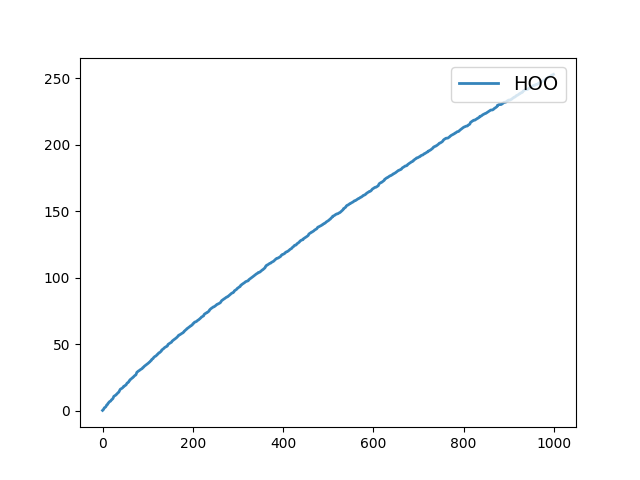
plot_regret(np.array(cumulative_regret_list), name='HOO')
The following lines of code are only for creating thumbnails and do not need to be used
# sphinx_gallery_thumbnail_number = 2
import matplotlib.pyplot as plt

fig = plt.figure()
ax = fig.add_subplot(111)

x = np.linspace(domain[0][0], domain[0][1], 1000)
z = x * (1-x) * (4 - np.sqrt(np.abs(np.sin(60 * x))))
ax.plot(x, z, alpha=0.9)
fig.subplots_adjust(left=0.1, right=0.9, top=0.9, bottom=0.1)

Total running time of the script: (0 minutes 2.101 seconds)