StoSOO Algorithm
Introduction
Title: Stochastic Simultaneous Optimistic Optimization
Authors: Michal Valko, Alexandra Carpentier, Remi Munos
Abstract: We study the problem of global maximization of a function f given a finite number of evaluations perturbed by noise. We consider a very weak assumption on the function, namely that it is locally smooth (in some precise sense) with respect to some semi-metric, around one of its global maxima. Compared to previous works on bandits in general spaces (Kleinberg et al., 2008; Bubeck et al., 2011a) our algorithm does not require the knowledge of this semi-metric. Our algorithm, StoSOO, follows an optimistic strategy to iteratively construct upper confidence bounds over the hierarchical partitions of the function domain to decide which point to sample next. A finite-time analysis of StoSOO shows that it performs almost as well as the best specifically-tuned algorithms even though the local smoothness of the function is not known.
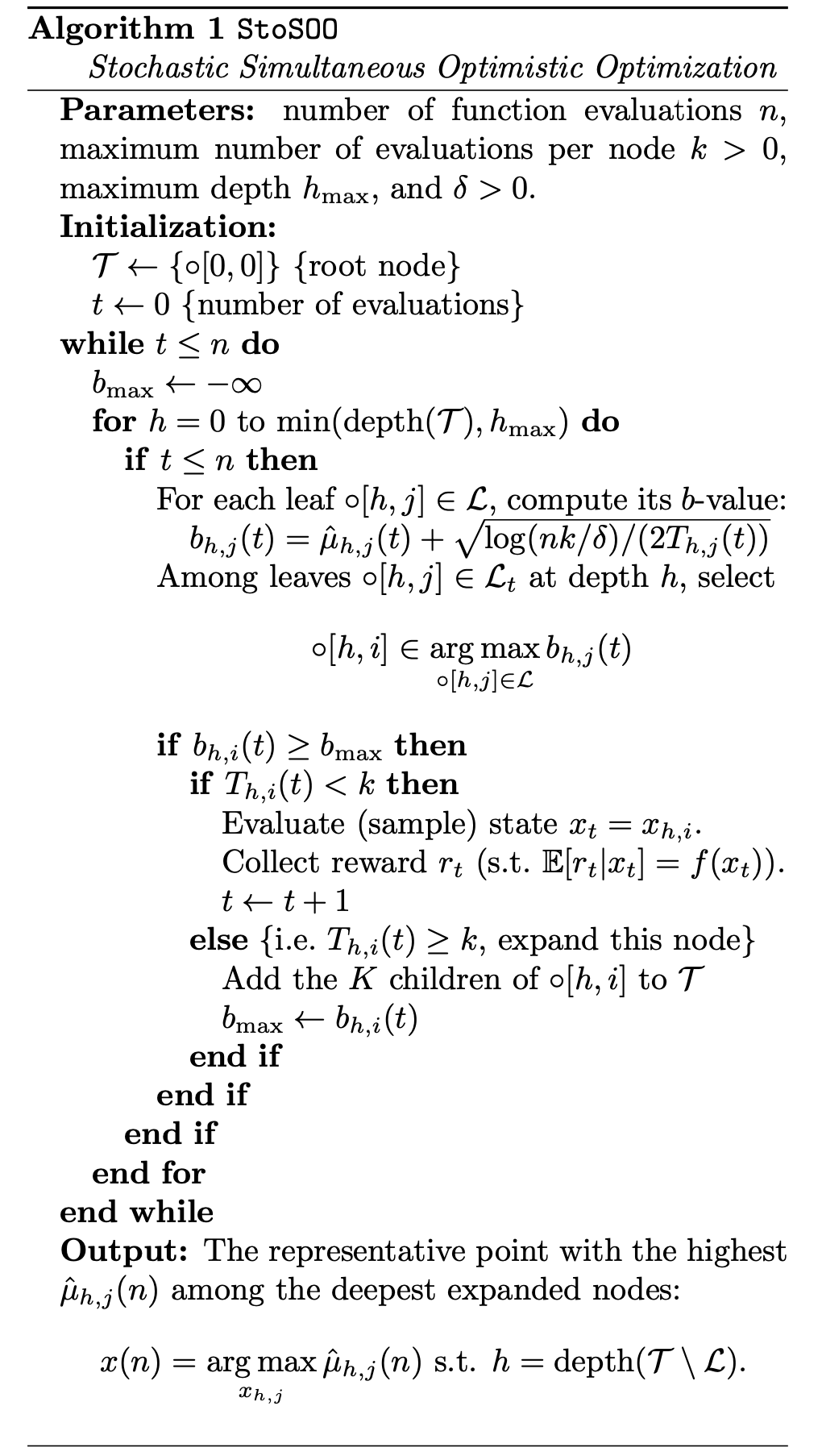
Algorithm Parameters
n (int) – The total number of rounds (budget)
k (int) - The maximum number of pulls per node
h_max (int) – The largest searching depth
delta (float) - The confidence parameter delta
domain (list(list)) – The domain of the objective to be optimized
partition – The partition choice of the algorithm. Default: BinaryPartition.
Usage Example
Note
Make sure to use get_last_point() to get the final output
from PyXAB.synthetic_obj.Garland import Garland
from PyXAB.algos.StoSOO import StoSOO

domain = [[0, 1]]               # Parameter is 1-D and between 0 and 1
target = Garland()
algo = StoSOO(domain=domain)

for t in range(1000):
    point = algo.pull(t)
    reward = target(point)
    algo.receive_reward(t, reward)

algo.get_last_point()