VHCT Algorithm
Introduction
Title: Optimum-statistical Collaboration Towards General and Efficient Black-box Optimization
Authors: Wenjie Li, Chi-Hua Wang, Guang Cheng, Qifan Song
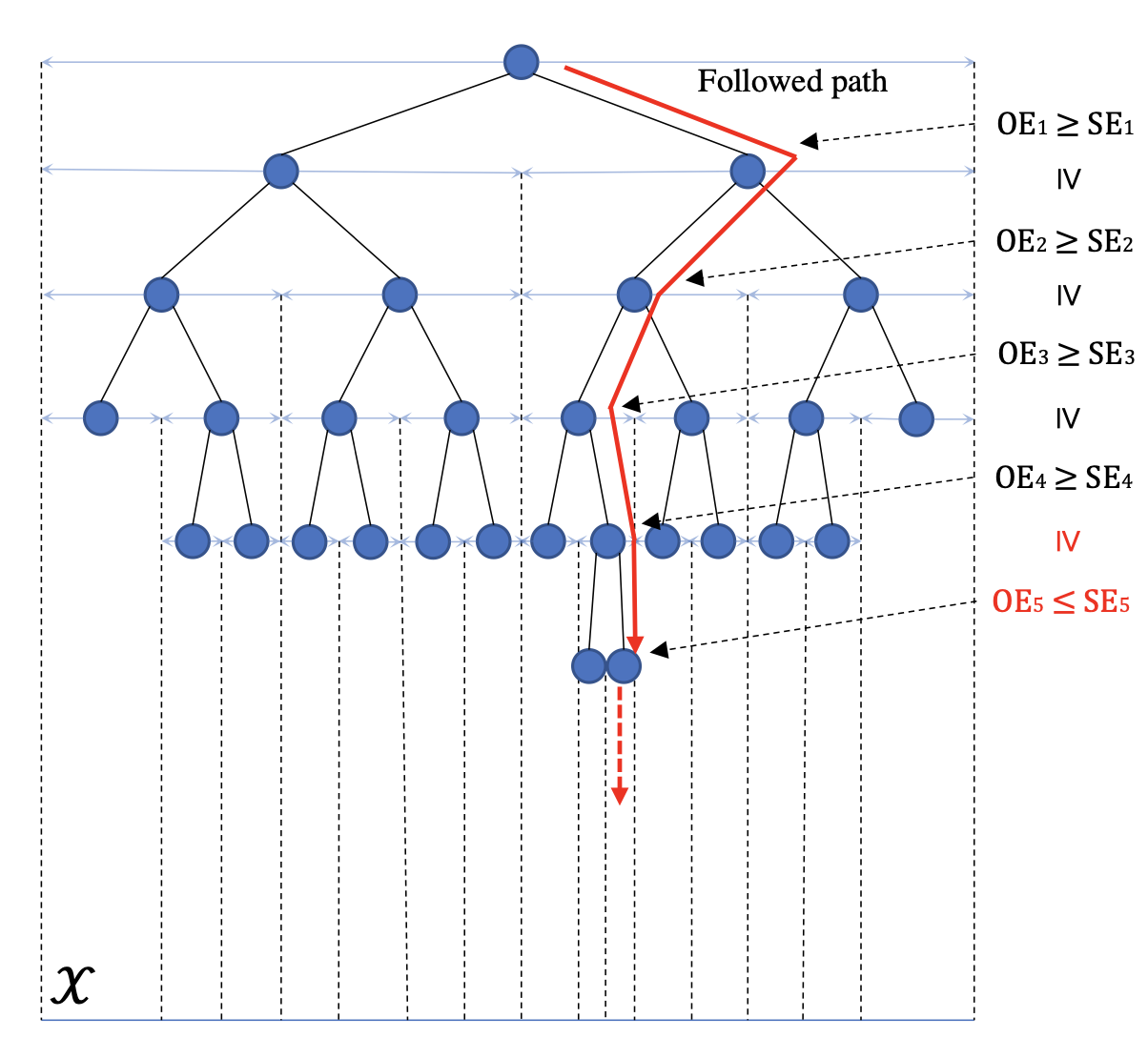
Abstract: In this paper, we make the key delineation on the roles of resolution and statistical uncertainty in hierarchical bandits-based black-box optimization algorithms, guiding a more general analysis and a more efficient algorithm design. We introduce the optimum-statistical collaboration, an algorithm framework of managing the interaction between optimization error flux and statistical error flux evolving in the optimization process. We provide a general analysis of this framework without specifying the forms of statistical error and uncertainty quantifier. Our framework and its analysis, due to their generality, can be applied to a large family of functions and partitions that satisfy different local smoothness assumptions and have different numbers of local optimums, which is much richer than the class of functions studied in prior works. Our framework also inspires us to propose a better measure of the statistical uncertainty and consequently a variance-adaptive algorithm VHCT. In theory, we prove the algorithm enjoys rate-optimal regret bounds under different local smoothness assumptions; in experiments, we show the algorithm outperforms prior efforts in different settings.
Algorithm Parameters
nu (float) – parameter nu of the VHCT algorithm
rho (float) – parameter rho of the VHCT algorithm
c (float) – parameter c of the VHCT algorithm
delta (float) – confidence parameter delta of the VHCT algorithm
bound (float) – the noise upper bound parameter bound
domain (list(list)) – The domain of the objective to be optimized
partition – The partition choice of the algorithm. Default: BinaryPartition.
Usage Example
from PyXAB.synthetic_obj.Garland import Garland
from PyXAB.algos.VHCT import VHCT

domain = [[0, 1]]               # Parameter is 1-D and between 0 and 1
target = Garland()
algo = VHCT(domain=domain)

for t in range(1000):
    point = algo.pull(t)
    reward = target(point)
    algo.receive_reward(t, reward)